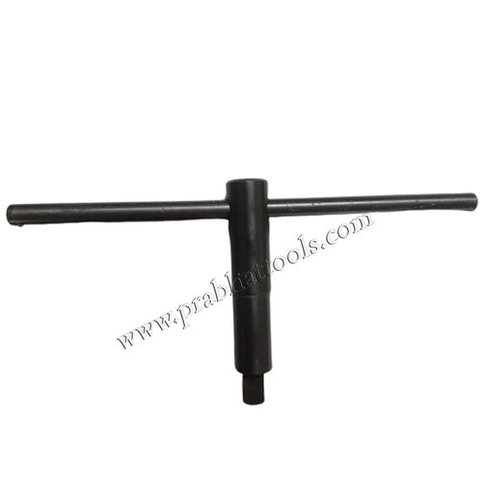
About Lathe Chuck Key
Our offered Lathe Chuck Key is a special type of clam that is used to hold a metal workpiece. It is used in metalworking and mechanical workshops in order to process a workpiece. In drilling and milling jobs, the Lathe Chuck Key hold a rotating tool. This is a versatile machine tool and is used in a variety of lathe machines. In a lathe machine, the chuck is mounted on the spindle that rotates within the headstock.
Specification :
HSN Code 8205
| No. | Capacity Inches | Price Each |
| CK-80 | 1/4 | 100-210 |
| CK-81 | 5/16 | 110-210 |
| CK-82 | 3/8 | 115-250 |
| CK-83 | 7/16 | 130-290 |
| CK-84 | 1/2 | 140-300 |
| CK-85 | 9/16 | 160-500 |
| CK-86 | 5/8 | 200-730 |
| CK-87 | 11/16 | 220-800 |
| CK-88 | 3/4 | 230-840 |
Engineered for Performance and SafetyOur lathe chuck keys are crafted from heavy-duty steel and finished with a black oxide coating to guard against corrosion. The cross-bar handle, integrated with non-slip knurling, offers secure handling in industrial settings, reducing slippage and boosting operator safety. Hardness rated between HRC 45 and 50 ensures lasting durability, supporting frequent and heavy-duty use.
Versatile Sizing for All Workshop NeedsWith sizes ranging from 4 mm to 20 mm, these lathe chuck keys accommodate various chuck configurations found in both small and large workshops. Their universal compatibility with 3-jaw and 4-jaw chucks eliminates the need for multiple tools and streamlines your workflow, making them suitable for professionals and hobbyists alike.
FAQ's of Lathe Chuck Key:
Q: How do I select the correct size lathe chuck key for my chuck?
A: To choose the appropriate lathe chuck key, measure the socket size of your lathe's chuck. Our keys are available in sizes from 4 to 20 mm, suitable for most standard 3-jaw and 4-jaw chucks. Consult your chuck's manual or manufacturer for precise compatibility.
Q: What are the benefits of the black oxide coating on the lathe chuck key?
A: The black oxide coating enhances the chuck key's resistance to rust and corrosion, which extends its service life and ensures reliable performance in humid or workshop conditions. This finish also gives the tool a professional appearance.
Q: When should I replace my lathe chuck key?
A: Replace your lathe chuck key if you notice significant wear, deformation, or reduced grip on the handle or key end. Regular inspection is recommended to maintain operational safety and prevent damage to your chuck.
Q: Where are these lathe chuck keys manufactured and exported from?
A: Our lathe chuck keys are manufactured in India and are available for export, supply, and trade worldwide. We cater to industrial, commercial, and educational sectors in various countries.
Q: What process ensures the hardness and durability of the chuck key?
A: The keys undergo a specialized heat-treatment process, achieving a hardness level of HRC 45-50, which ensures excellent wear resistance and long-term durability under frequent and heavy use.
Q: How does the non-slip knurled handle improve usage?
A: The knurled, non-slip handle provides an enhanced grip, especially in oily or wet conditions. This design minimizes the risk of slipping and allows precise application of torque for secure chuck tightening or loosening.
Q: What are the typical applications of this lathe chuck key?
A: These keys are primarily used to operate 3-jaw and 4-jaw lathe chucks, facilitating quick and secure installation or removal of workpieces. They're essential for machinists across various industries and for educational training workshops.
 +918010754649


 Send Inquiry



 Send Inquiry
 Send Inquiry
 Call Me Free
 English
 Spanish
 French
 German
 Italian
 Chinese (Simplified)
 Japanese
 Korean
 Arabic
 Portuguese